What Foods Interact With Tacrolimus? Essential Guide
What foods interact with tacrolimus? Grapefruit, pomegranate and Seville oranges raise levels; potassium and meal timing matter too. A plain guide for transplant patients.

By Reece Douglas · Founder, FreshPlate
Listen to this article
What Foods Interact With Tacrolimus? Essential Guide
Grapefruit is the food most strongly linked to tacrolimus problems. It can raise the amount of drug in your blood, and tacrolimus has a narrow safe range, so even modest shifts matter.
Pomegranate, Seville oranges, high-potassium foods and irregular meal timing also matter. This guide covers each, with practical limits and timings. Your transplant team has the final word on your dose and diet.
I built FreshPlate so that a rule like this one is not something you have to remember at the supermarket. You add your medicines by brand or generic name, and every recipe the app generates is built around that list. For tacrolimus, grapefruit and grapefruit juice are a hard block, so they never appear in a recipe for you. Each recipe also has a For you tab listing your medicines, so you can see what was checked. The app is still in the making, but the free interaction checker on the website works now: type in tacrolimus and see the foods to watch.
Which foods interact with tacrolimus?
Grapefruit, pomegranate and Seville oranges are the foods most clearly linked to interactions with tacrolimus, and the evidence is strongest for grapefruit. Tacrolimus is broken down by an enzyme in the gut wall and liver called CYP3A4. Compounds in these fruits block that enzyme, so more tacrolimus reaches your bloodstream than your dose was designed to deliver.
Tacrolimus has a narrow therapeutic window. Too little raises the risk of rejection; too much can damage the kidneys, raise blood pressure and blood sugar, and cause tremor or headaches. Transplant teams therefore measure trough blood levels regularly and adjust the dose to match.
- Grapefruit and grapefruit juice — avoid — blocks CYP3A4 and can raise tacrolimus levels
- Seville oranges (marmalade) — avoid — contain similar enzyme-blocking compounds to grapefruit
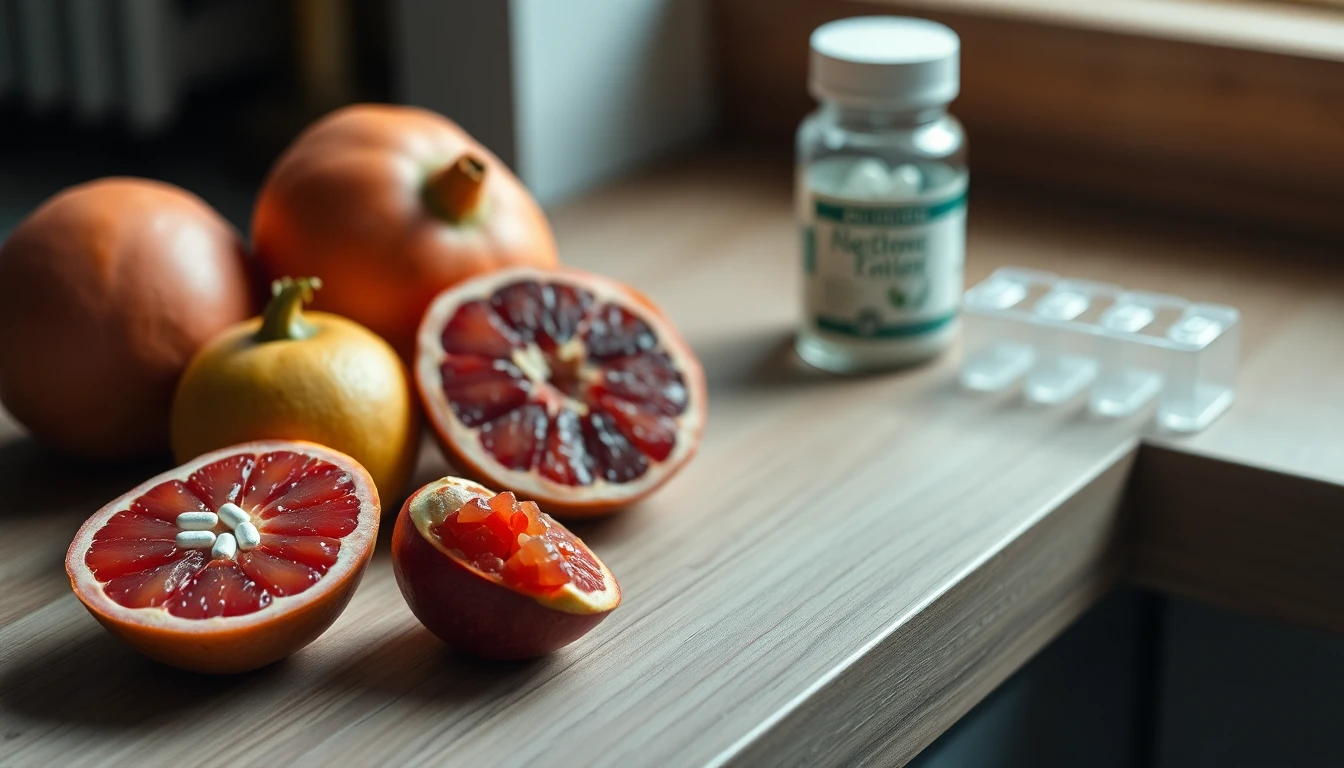
- Pomegranate and pomegranate juice — avoid unless your team says otherwise — reported to affect tacrolimus levels
- Sweet oranges, satsumas, clementines — generally fine — not shown to affect this enzyme in the same way
- Pomelo — avoid — closely related to grapefruit and contains similar compounds
- St John's wort (herbal) — avoid — lowers tacrolimus levels and has caused rejection episodes
Can you eat grapefruit while taking tacrolimus?
No. Avoid grapefruit and grapefruit juice completely while you take tacrolimus. The enzyme-blocking effect can last a day or more, so spacing the fruit away from your tablet does not make it safe.
There is no known safe amount. The effect varies between people and between fruit, so a single glass of juice can change your blood level unpredictably. If you have eaten some by accident, tell your team, or they cannot explain an unexpected result.
Hidden sources of grapefruit and Seville orange
Check labels. Grapefruit and Seville orange turn up in unexpected places and are easy to miss on a quick shop.
- Marmalade — check the label — traditional marmalade uses Seville oranges
- Fruit juice blends and smoothies — check the label — grapefruit is common in multi-fruit drinks
- Flavoured sparkling water and soft drinks — check the label — some contain grapefruit or pomelo flavouring
- Fruit salads and salad bars — ask — grapefruit segments are common
- Herbal teas and gin and tonic-style mixers — check the label — Seville orange peel is used as a flavouring
What to do if you ate some by accident
Do not skip or change your tacrolimus dose yourself. Tell your transplant team or pharmacist how much you ate and when, and ask whether your next blood test should be brought forward. One accidental exposure is usually dealt with by monitoring.
Should you limit potassium while taking tacrolimus?
Sometimes. Tacrolimus can raise blood potassium, and a high level can disturb heart rhythm, so many transplant patients are asked to watch high-potassium foods, particularly in the early months after surgery or if kidney function is reduced. It depends on your blood results, so follow your renal or transplant dietitian rather than a general rule.
Do not cut potassium on your own initiative. Potassium is an essential mineral, and a blanket restriction can leave you short. If your blood potassium is normal and your team has not mentioned it, you may not need to restrict anything. If you also have reduced kidney function, the stage 3 chronic kidney disease diet guide explains how potassium advice is usually approached.
If you also take an ACE inhibitor or similar blood pressure tablet, the two effects can add together. The ACE inhibitor potassium foods guide covers that overlap.
- Bananas — limit if advised — roughly 400 mg potassium in a medium banana
- Potatoes and sweet potatoes — limit if advised — a medium baked potato with skin can provide over 900 mg
- Tomato purée and tomato sauces — limit if advised — concentrated, so potassium adds up quickly
- Dried fruit (apricots, raisins, dates) — limit if advised — potassium is concentrated when water is removed
- Coconut water — limit if advised — often higher in potassium than people expect
- Salt substitutes (potassium chloride) — avoid unless your team agrees — can deliver a large potassium dose quickly
- Apples, berries, rice, pasta, white bread — usually fine — lower in potassium
Should you take tacrolimus with food or on an empty stomach?
Take tacrolimus the same way every day, either always with food or always without, because food, especially a fatty meal, reduces absorption and consistency matters more than the choice. If your habit swings between breakfast and no breakfast, your blood levels will swing with it.
The product information for immediate-release tacrolimus capsules advises taking them on an empty stomach, at least one hour before or two to three hours after a meal, for maximum absorption. Prolonged-release versions are generally taken in the morning, with similar attention to food. Check your own leaflet and ask your pharmacist, as brands differ and are not interchangeable without supervision.
- Same time every day — essential — twice daily capsules are usually about 12 hours apart
- Same relationship to meals — essential — a fatty breakfast one day and none the next changes absorption
- One hour before or two to three hours after food — typical advice for immediate-release capsules — maximises absorption
- Trough blood test mornings — wait to take your dose until after the blood sample, if your clinic asks — so the result reflects the lowest level
- Changing brand — only with your team — different products are not directly interchangeable
Practical routines that keep levels steady
Link your dose to something fixed, such as brushing your teeth, and set a phone alarm for both doses. If you work shifts or travel across time zones, ask your team for a plan in advance. Keep meals broadly regular too, since big swings in what you eat can shift absorption.
If you are sick or cannot eat
Vomiting or diarrhoea can change how much tacrolimus you absorb. Contact your transplant team the same day if you cannot keep a dose down, and do not double up the next one without advice.
Other food and drink points for transplant patients
Tacrolimus lowers your defences against infection, so food safety matters more. The NHS advises people with weakened immune systems to take particular care with certain foods, because infections such as listeria and salmonella can be more serious. Wash raw fruit and vegetables, cook meat and eggs thoroughly, and check use-by dates.
Alcohol is not forbidden for every transplant patient, but it adds load to the liver and can interact with other medicines, so agree a limit with your team. Tacrolimus can also raise blood sugar; the blood sugar control foods post is a useful starting point.
- Unpasteurised milk, soft mould-ripened cheese and pâté — avoid or check with your team — higher listeria risk
- Raw or runny eggs, undercooked meat, raw shellfish — avoid — higher risk of food poisoning
- Herbal supplements — ask first — St John's wort lowers levels, and others have little safety data alongside tacrolimus
- Alcohol — agree a limit with your team — adds liver load and can interact with other medicines
- Sweet oranges, apples, berries, pears — fine — wash well before eating
How FreshPlate keeps tacrolimus-safe eating simple
FreshPlate builds recipes around your medications, so grapefruit, Seville orange and pomegranate are screened out of your meal plans automatically, and potassium-conscious options are available if your team has asked you to watch it. Tell the app your dose times and it will plan meals around your routine.
FreshPlate also offers a free food–medication interaction checker to look up any food or drink against tacrolimus in seconds. Use it alongside, not instead of, advice from your transplant team and pharmacist.
Frequently asked questions
Do beta blockers interact with food?
+
Yes, some do, though the effects are usually modest. Taking certain beta blockers such as propranolol or metoprolol with food can increase absorption, and grapefruit or large amounts of liquorice can matter for some people, so check your own leaflet. If you take a beta blocker alongside tacrolimus, tell your pharmacist so both are checked together.
Can I eat grapefruit if I take tacrolimus?
+
No. Grapefruit and grapefruit juice can raise tacrolimus levels in the blood, and spacing them away from your dose does not remove the effect. Avoid Seville oranges and pomelo as well.
Does pomegranate interact with tacrolimus?
+
Pomegranate is reported to affect how tacrolimus is handled by the body, so avoid pomegranate fruit and juice unless your transplant team has said otherwise. The evidence is less firm than for grapefruit, but tacrolimus has little margin for error.
Should I take tacrolimus with food?
+
Be consistent: always take it the same way each day, because food reduces absorption. Immediate-release capsules are usually taken on an empty stomach, one hour before or two to three hours after eating. Follow your own leaflet and your team's advice.
Do I need to avoid potassium with tacrolimus?
+
Not automatically. Tacrolimus can raise blood potassium, so your team may ask you to limit foods such as bananas, potatoes and tomato purée depending on your results. Do not restrict potassium without being told to.
Sources
Did this answer your question?
Reece reads every reply. Questions we have not covered become new guides.
Eating around tacrolimus shouldn’t be guesswork.
Get our free tacrolimus food guide by email — the foods to watch, safe swaps, and meal ideas that work with your medication. One genuinely useful email a week — no spam, unsubscribe anytime.
Free forever. You'll also be first in line for the FreshPlate app — with a free trial at launch.